
Receive the latest reviewed off-market opportunities across cars, homes, yachts and private jets, delivered privately to your inbox.
Thank you. You'll receive the latest reviewed off-market opportunities from HYPERLUXE, delivered privately to your inbox.
By subscribing, you agree to HYPERLUXE's Privacy Policy. You can unsubscribe at any time via the link in any email.
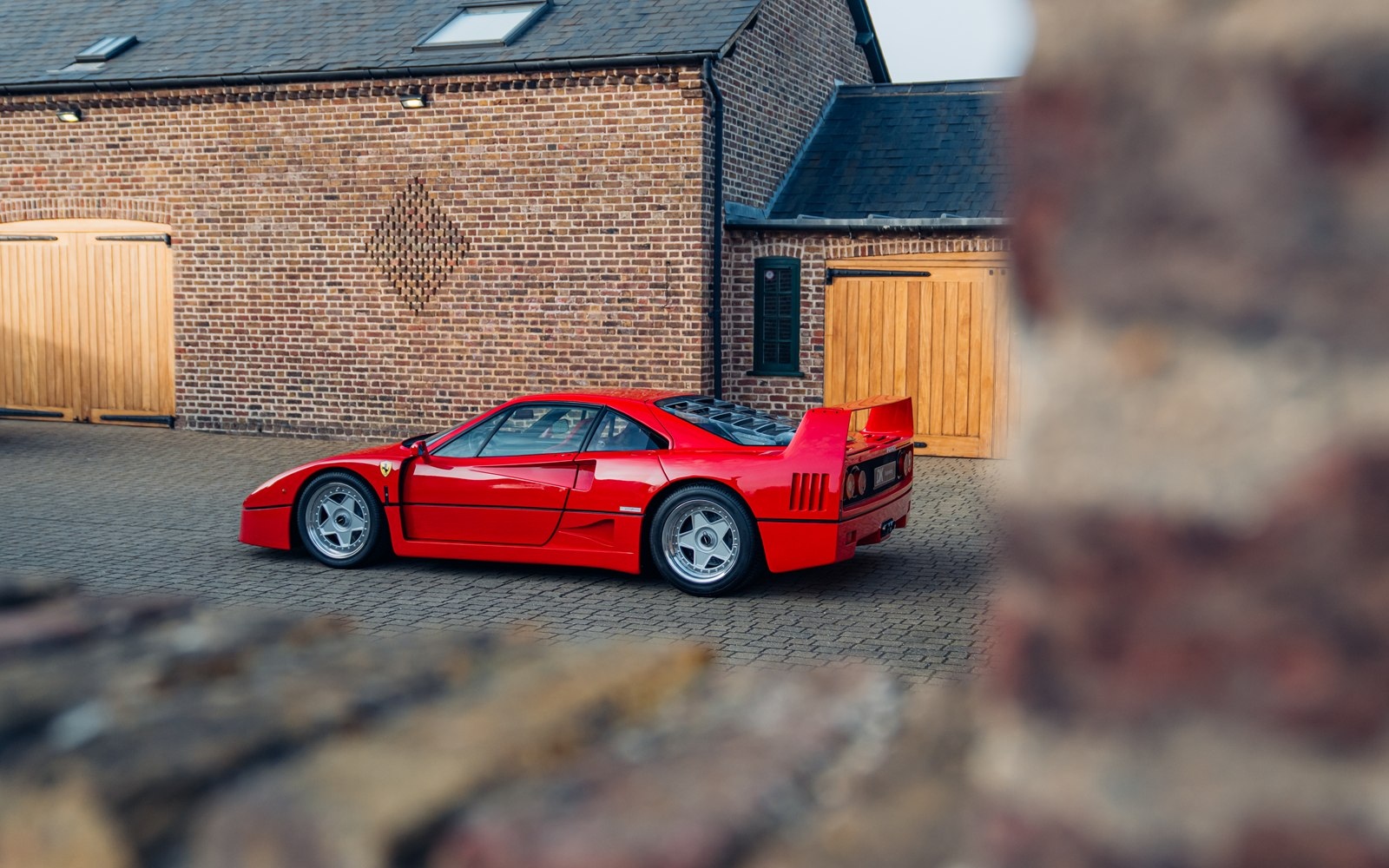
The Ferrari F40 is the 1,315-unit twin-turbo V8 berlinetta built for Ferrari's 40th anniversary and the last car developed under Enzo Ferrari's lifetime. HYPERLUXE currently references 3 Ferrari F40 public listings and 24 Ferrari F40 off-market listings, so a qualified inquiry can open access well beyond the cars visible on this page.
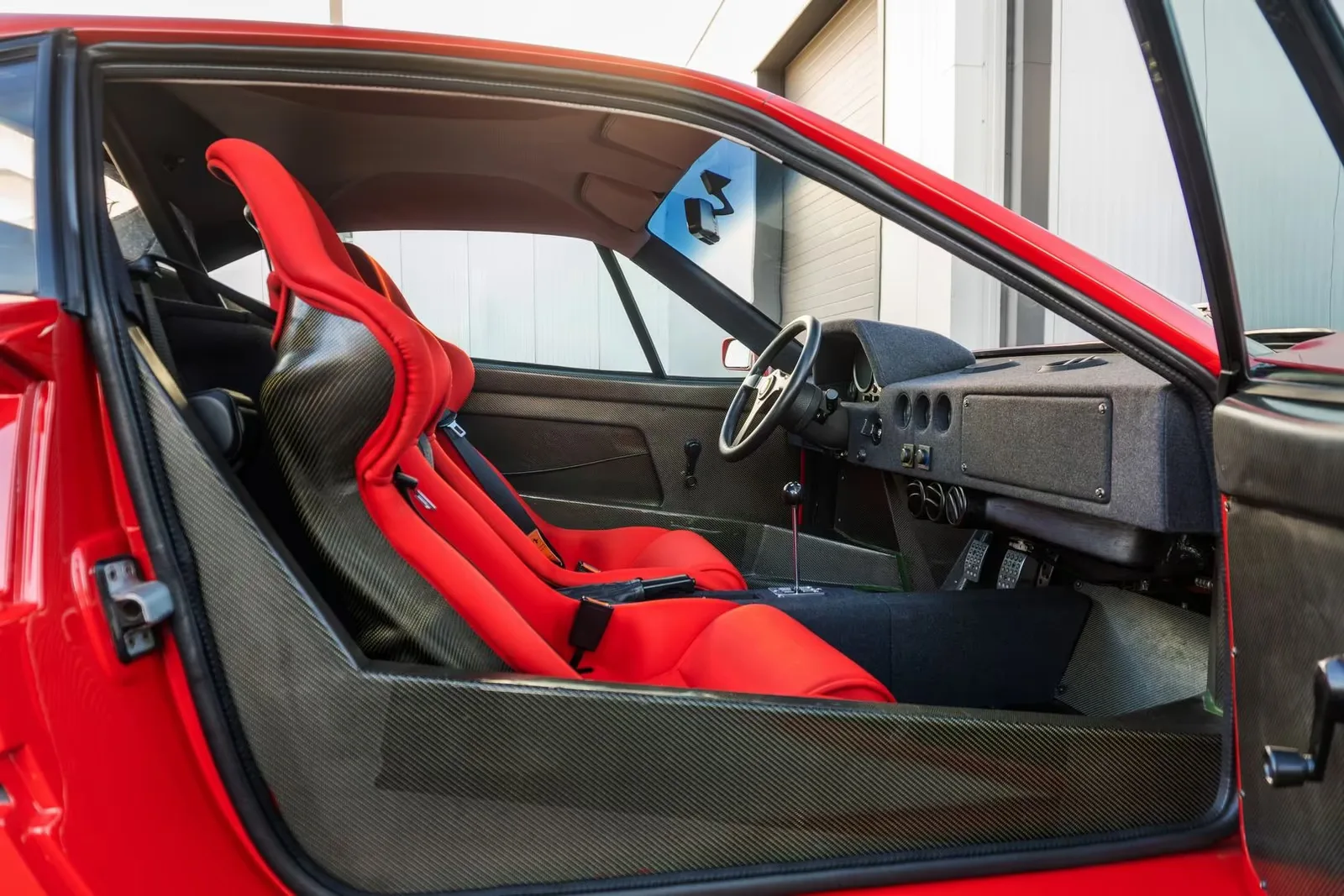
The F40 is not a romantic V12 Ferrari, it is a breakthrough car: a 2.9-litre twin-turbo V8, minimal driver aids, a stripped composite cabin in Kevlar, carbon fibre and Nomex, and one of the first production road cars to exceed 200 mph. Its value comes from mechanical purity, historical status and permanent global demand rather than from raw production scarcity.
The Ferrari F40 is a rear mid-engine, rear-wheel-drive berlinetta built to mark Ferrari's 40th anniversary and engineered from the 288 GTO Evoluzione concept. Designed by Pininfarina under Leonardo Fioravanti and Pietro Camardella, it pairs a tubular steel spaceframe with a composite body in carbon fibre, Kevlar and Nomex, a 2,936 cc twin-turbo V8 and a five-speed gated manual, with no ABS, no traction control, no power steering and almost no luxury content. It is the last Ferrari supercar developed under Enzo Ferrari's lifetime.
For buyers, the opportunity is not only the cars shown publicly here. HYPERLUXE references 24 off-market F40 listings through seller-side access, which is why a direct inquiry matters: production is high for a Ferrari halo car, but genuinely high-quality, well-documented examples are far more limited than the 1,315 figure suggests.
Key Numbers
| Model name | Ferrari F40 |
| Manufacturer | Ferrari S.p.A. |
| Production years | 1987-1992 (road cars) |
| Purpose | 40th anniversary Ferrari flagship |
| Layout | Rear mid-engine, rear-wheel drive |
| Body style | 2-door berlinetta / coupé |
| Designer | Pininfarina (Fioravanti / Camardella) |
| Engineering base | Ferrari 288 GTO Evoluzione-derived |
| Production volume | 1,315 units (some sources 1,311) |
| US-spec production | 213 units |
| Successor | Ferrari F50 |
| Original MSRP | $399,150 in 1987 |
Engine and Powertrain
| Engine code | Tipo F120A / F120D (market/spec) |
| Engine type | 90° V8, twin-turbocharged, intercooled |
| Displacement | 2,936.25 cc |
| Bore x stroke | 82.0 mm x 69.5 mm |
| Valvetrain | DOHC, 4 valves per cylinder, 32 valves |
| Induction | Twin IHI turbochargers |
| Intercoolers | Twin Behr intercoolers |
| Fuel system | Weber-Marelli electronic injection |
| Compression ratio | Approx. 7.7:1 |
| Maximum power | 478 PS / 471 hp / 351.5 kW at 7,000 rpm |
| Maximum torque | Approx. 577 Nm / 425 lb-ft at 4,000 rpm |
| Clutch | Twin-plate clutch |
| Exhaust | Triple-outlet, central wastegate pipe |
Transmission and Drivetrain
| Transmission | 5-speed manual, gated gearbox |
| Drive | Rear-wheel drive |
| Clutch | Twin-plate |
| Differential | Limited-slip differential |
| Driver aids | No traction control, no stability control |
| Steering | Manual rack-and-pinion, no power steering |
Performance
| Top speed | 324 km/h / 201 mph |
| 0-100 km/h | Approx. 4.1 seconds |
| 0-60 mph | Approx. 3.8-4.0 seconds |
| 0-400 m | Approx. 11.9 seconds |
| 0-1,000 m | Approx. 20.9 seconds |
| Power-to-weight | Approx. 434 PS/tonne (1,100 kg dry) |
| Redline | Around 7,750 rpm |
| Braking | No ABS on original road cars |
Chassis, Body and Aerodynamics
| Chassis | Tubular steel spaceframe |
| Body materials | Carbon fibre, Kevlar, Nomex composite |
| Aerodynamics | Fixed rear wing, NACA ducts, vented cover |
| Drag coefficient | Approx. Cd 0.34 |
| Front suspension | Double wishbones, coil springs, anti-roll bar |
| Rear suspension | Double wishbones, coil springs, anti-roll bar |
| Dampers | Koni |
| Brakes | Ventilated discs front and rear, approx. 330 mm |
| ABS | No |
Dimensions and Weight
| Length | Approx. 4,430 mm |
| Width | Approx. 1,970-1,980 mm |
| Height | Approx. 1,124-1,130 mm |
| Wheelbase | Approx. 2,450 mm |
| Front track | Approx. 1,594-1,595 mm |
| Rear track | Approx. 1,606-1,610 mm |
| Dry weight | Approx. 1,100 kg (commonly cited) |
| Kerb weight | Approx. 1,235-1,369 kg (market/spec) |
| Fuel tank | Approx. 120 litres |
Wheels and Tyres
| Wheels | 17-inch five-spoke, magnesium/alloy |
| Front tyres | 245/40 ZR17 |
| Rear tyres | 335/35 ZR17 |
| Front brakes | Ventilated discs, approx. 330 mm |
| Rear brakes | Ventilated discs, approx. 330 mm |
| ABS | Not fitted to original road cars |
Interior and Equipment
| Seats | Lightweight bucket seats |
| Upholstery | Stoffa Vigogna cloth, typically red |
| Door release | Pull cords, no conventional handles |
| Windows | Early sliding Perspex; later wind-up |
| Carpets | Early lightweight cars largely without |
| Air conditioning | Many later and US-spec cars |
| Audio | Generally absent from original concept |
| Instruments | Analogue gauges |
| Luggage | Minimal; some Schedoni accessories/folio |
Production and Variants
| Early EU non-cat / non-adjust | Most pure, highly sought after |
| European cat / adjust | Later cars, catalysts, adjustable suspension |
| US-spec F40 | 213 units, market-specific equipment |
| Sliding-window cars | Earliest examples, collector premium |
| Wind-up window cars | More common, later production |
| F40 LM | Around 19, Michelotto-built racing |
| F40 Competizione | Very limited, often cited around 10 |
| F40 GT / GTE | Very low numbers, track evolutions |
Market Data
| Original MSRP | $399,150 in 1987 |
| Driver-quality EU car | Approx. $2.5M-$3.2M |
| Strong EU, low mileage | Approx. $3M-$4M+ |
| US-spec, strong condition | Often $3M+ |
| Exceptional / Classiche | $4M-$5M+ possible |
| Hagerty "Good" (1991) | Around $2.7M (+12.5%) |
| RM Miami 2025, US-spec | $3,580,000 |
| RM Monaco 2026, non-cat | €4,336,250 (1,799 km) |
| HYPERLUXE count | 3 public and 24 off-market listings |
What Drives Value
| Specification | Non-cat / non-adjust prized in Europe |
| Market | US-spec premium (only 213 built) |
| Mileage | Low matters only with credible condition |
| Classiche | Authenticity, matching-numbers signal |
| Provenance | Ownership, history, original books |
| Originality | Paint, interior, engine, panels, tools |
| Maintenance | Tanks, belts, clutch, turbos, brakes |
| Accident history | Composite repair quality is critical |
Historical Significance
| Anniversary car | Ferrari's 40th anniversary flagship |
| Enzo Ferrari link | Last supercar of his lifetime |
| 200 mph status | Ferrari's first 200 mph production car |
| Character | Road-legal, competition-derived, raw |
| Engine philosophy | Twin-turbo V8, not a romantic V12 |
| Predecessor | Ferrari 288 GTO |
| Successor | Ferrari F50 |
| Core identity | Mechanical purity over outright scarcity |
Ferrari F40 pricing is highly specification-sensitive. HYPERLUXE uses $2.8M-$4M as model-level guidance for collector-quality cars, with driver-grade European examples closer to $2.5M-$3.2M and exceptional low-mileage, Classiche-certified or top-provenance cars reaching $4M-$5M+. Public data ranges broadly from $2.7M to $5M+, and competition derivatives such as the F40 LM can exceed $8M-$10M+ depending on history.
Low mileage is not automatically better: a car stored for 20 years can need very costly recommissioning: the RM Monaco 2026 example cited over €165,000 of work at Michelotto. Before buying, verify VIN/chassis plate, engine number, gearbox number, body number, Ferrari Classiche Red Book and matching-numbers status, original books and tool roll, Schedoni folio, full service history (fuel tanks, belts, clutch, turbos, brakes, suspension), mileage consistency, original paint versus repaint on composite panels, accident and structural inspection, delivery market (EU / US / Middle East / Japan), VAT and import/registration status, and seller authority. Serious dossiers typically require proof of funds.
HYPERLUXE · F40 Availability
Only three F40s are public on this page. Submit an inquiry to access the wider private F40 pool and receive chassis, build, ownership, service and seller-side information after qualification.
FAQ
Key questions about production, the twin-turbo V8, performance, market range and private access.
Production is usually cited as 1,315 units, though some sources state 1,311. Of these, 213 were built to US specification. Initial plans were for roughly 400 cars, but demand pushed Maranello well beyond that figure.
HYPERLUXE currently references 3 public Ferrari F40 listings and 24 off-market listings. The private pool is accessible only after a qualified inquiry.
The Ferrari F40 launched with an MSRP of $399,150 in 1987, sold through Ferrari's official network to pre-qualified clients.
The F40 uses a 2,936 cc 90-degree twin-turbocharged, intercooled V8 producing 478 PS / 471 hp / 351.5 kW at 7,000 rpm and around 577 Nm of torque, driving the rear wheels through a 5-speed gated manual gearbox.
No. Unlike the V12 Ferraris around it, the F40 is twin-turbocharged. Its character comes from turbo response, low weight and minimal driver aids rather than from a high-revving naturally aspirated engine.
Ferrari quotes a top speed of 324 km/h / 201 mph, 0-100 km/h in about 4.1 seconds and 0-60 mph in roughly 3.8-4.0 seconds. It is one of the first production road cars to exceed 200 mph, and Ferrari's first 200 mph production car.
Public data ranges broadly from $2.7M to $5M+. Driver-quality European cars sit around $2.5M-$3.2M, strong low-mileage cars $3M-$4M+, and exceptional Classiche-certified examples $4M-$5M+. Recent results include RM Miami 2025 at $3,580,000 and RM Monaco 2026 at €4,336,250 for a non-cat, non-adjust car with 1,799 km.
Not automatically. Mileage matters only when mechanical condition is credible. A long-stored car can require very expensive recommissioning, fuel tanks, belts, clutch, turbos and brakes, so service history and originality matter as much as the odometer.
Verify chassis, engine, gearbox and body numbers, Ferrari Classiche Red Book and matching-numbers status, original books, tools and Schedoni folio, full service history, fuel-tank age, mileage consistency, original paint versus repaint on composite panels, accident and structural condition, delivery market, VAT/import status and seller authority.
 EN
EN AR
AR ZH
ZH HI
HI RU
RU